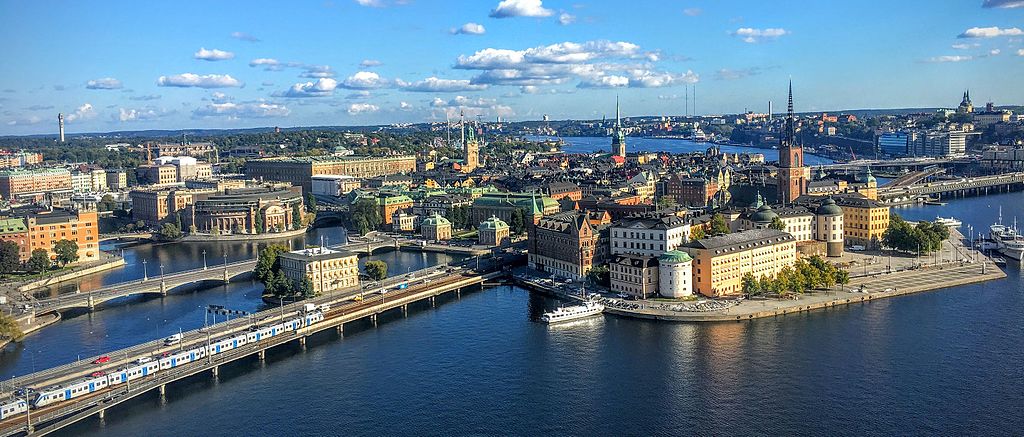
For more than a decade, I have been in touch with colleagues in Sweden about a possible visit there to begin an exploration of the lives of Muslim and Arab Swedes. I was finally able to follow through this month.
My primary interlocutor was Dr. Frederic Brusi, a scholar of contemporary Sufism and an official at the Swedish Agency for Support to Faith Communities, a governmental office part of the Swedish Ministry of Health and Foreign Affairs. Dr. Brusi graciously corresponded with me before my trip and met with me in Stockholm. Dr. Brusi’s agency publishes reports about religion in both English and Swedish, and I found Erika Willander’s The Religious Landscape of Sweden to be a very helpful orientation to the varieties of Swedish Muslim organizations as well as the different religious backgrounds of Arab Swedes. The report estimates that about 150,000 Swedes affiliate with a Muslim congregation or other organization (so, this does not necessarily include “un-mosqued” people who may still self-identify as Muslim) while almost 50,000 Swedes affiliate with the Syrian Orthodox Church. Arabic-speaking Swedes are also members of the Coptic Orthodox Church, the Assyrian Church of the East, and the Armenian Apostolic Church. The self-described “Oriental Catholic Churches” also operate in Sweden.

The reason for the robust presence of these Arabic-speaking Swedish religious communities is a history of immigration that dates from the post-World War II period. Of the 10.5 million inhabitants of Sweden, more than 2 million were born outside the country. Over 900,000 are from Europe, but there is a sizeable number of Arabic speakers, too: about 200,000 from Syria, 150,000 from Iraq, and 30,000 from Lebanon. Though the categories of Muslim and Arab sometimes overlap, the Muslim community in Sweden is a global one, just like in the United States. Among the largest Muslim populations are those with roots in Iran (85,000), Somalia (70,000), Afghanistan (65,000), Bosnia (60,000), Turkey (55,000), and Eritrea (50,000).
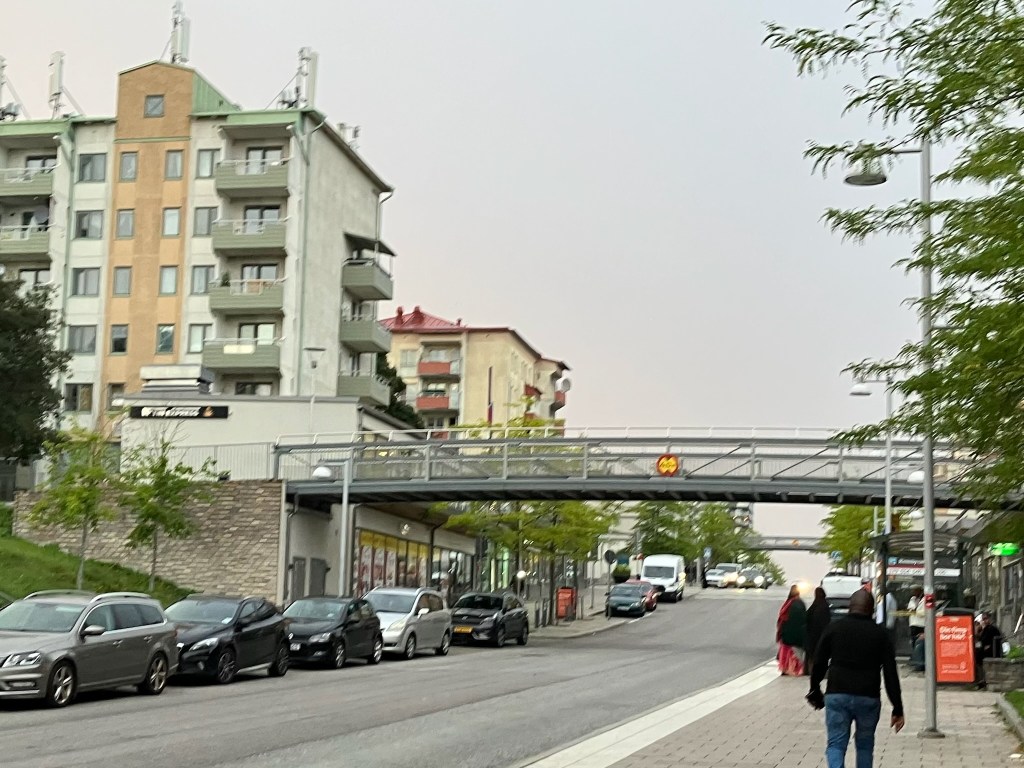
A number of these persons came to Sweden as refugees, and my first impression, right or wrong, was that they receive better governmental support than refugees in the United States. For example, when I visited the Rinkeby suburb, stereotyped incorrectly as a dangerous “no-go” zone by Islamophobes, I was impressed first by the infrastructure. As in the rest of Sweden, it is nearly impossible to find a pothole, the sidewalks are fully accessible, and the public transportation is excellent. Eritrean, Ethiopian, and Somali Swedes were closing up shop for the day, but some lingered to watch football together. I ate falafel at “Johnny’s” shop, and had a nice chat in Arabic. Johnny told me that Syrians lived all over the suburbs, and that Rinkeby had more residents from the Horn of Africa than it did Syrians.
Though Arabs and Muslims benefit from the Swedish social welfare system, they face legal and extra-legal discrimination, too. Some of this racism is explicit and ugly Islamophobia. Some of it is more casual. When I visited the Vasa Museum with a couple of indigenous Arabic speakers, for example, I discovered that the site offered brochures and audio guides in dozens of languages but did not have copies of the brochure in Arabic. I asked about it at the information desk. The response was, “maybe they don’t come here.” That seemed wrong to me, especially since Arabic-speaking Swedish schoolchildren are made to visit as part of their education. But it did strike me that there weren’t many Arab and Muslim families present. This was different than other sites nearby, including the Skansen museum. A public historian would be prone to ask, “why is that, in one of the most popular museums in Europe, that Arabs don’t come, or is that simply the museum staff’s impression”? I couldn’t help but wonder if the exchange indicated a larger cultural issue in Sweden: the onus to participate in Swedish society in this instance seems to be on Arabs rather than seen as a partnership.
Part of the problem is that the government treats Muslims and Arabs as people who possess fundamentally problematic cultural values, according to research by Annika Rabo, Paula Estrada Tun, Emma Jörum. Their Journal of Refugee Studies article entitled “Syrians in Sweden: Constructing Difference Regarding Gender and Family” examines how the Swedish state has “constructed cultural divisions between ‘native’ Swedes and Syrian migrants.” They show how the state depicts migrants as “coming from ‘patriarchal’ and ‘collectivist’ cultures and are therefore in need of development,” especially regarding practices such as clitoridectomy/FGM. This narrative was apparent from day one of my visit. One of the very first Swedes with whom I spoke upon arrival at Stockholm’s Central Station was a volunteer for an NGO seeking to empower immigrant women and prevent what the person described in English as “mutilation.” Among the many problems generated by these stereotypes about non-white men and women is that such racism invites government control of migrant families and in turn prompts migrants to defend their “traditional,” non-Swedish values, according to Rabo, Tun, and Jörum.
The problem of the state reifying cultural difference reminds me of Riem Spielhaus’ research on Turkish Germans, which shows how the German state categorized and built government offices to deal with Turkish immigrants not as an ethnic group, but as a religious one. According to Spielhaus, the state created a homogenized form of Islam that did not exist prior to the Turks’ arrival in Germany, and it forced Turks to deal with the state as Muslims even if they did not want to do so.
Something similar may be happening in Sweden. For most of Swedish history, Swedish citizenship was coterminous with membership in the (Evangelical Lutheran) Church of Sweden. One’s political status was tied to religious community. Despite the secular orientation of many Swedes, the cultural norms of Sweden, its sense of time (including the calendar of holidays), its architecture and other aestethics, its social networks, its public rituals, its historical origin stories, and other aspects of society remain religious and mainly Christian. Religious diversity and pluralism are embraced by some as a solution to the enfranchisement of migrants and other outsiders.
But as I was beginning my search for Arab Sweden, I couldn’t help but wonder whether attention to other forms of culture, especially ethnicity, might also help nurture the ideal that many Swedish liberals embrace–that every Swede, regardless of background, has equal opportunity to shape their destiny not only as an individual but as member of many communities, some religious, some not. The rich, multi-religious, multi-cultural identity of Arabic-speaking Swedes was all around me–from the Syrian Armenian restaurant where Moroccans and Egyptians found employment to the Arabic music I heard in taxis and a hookah bar. Perhaps when I visit again I will find more public acknowledgement of the cultural fluorescence of Arab ethnicity.
 Edward E. Curtis IV
You must be logged in to post a comment.