
As lead author of the three historical panels to be installed on the South Street Extension of the Indianapolis Cultural Trail, I was invited by cultural trail leader Kären Haley to give some brief remarks at the ribbon cutting on October 29, 2024.
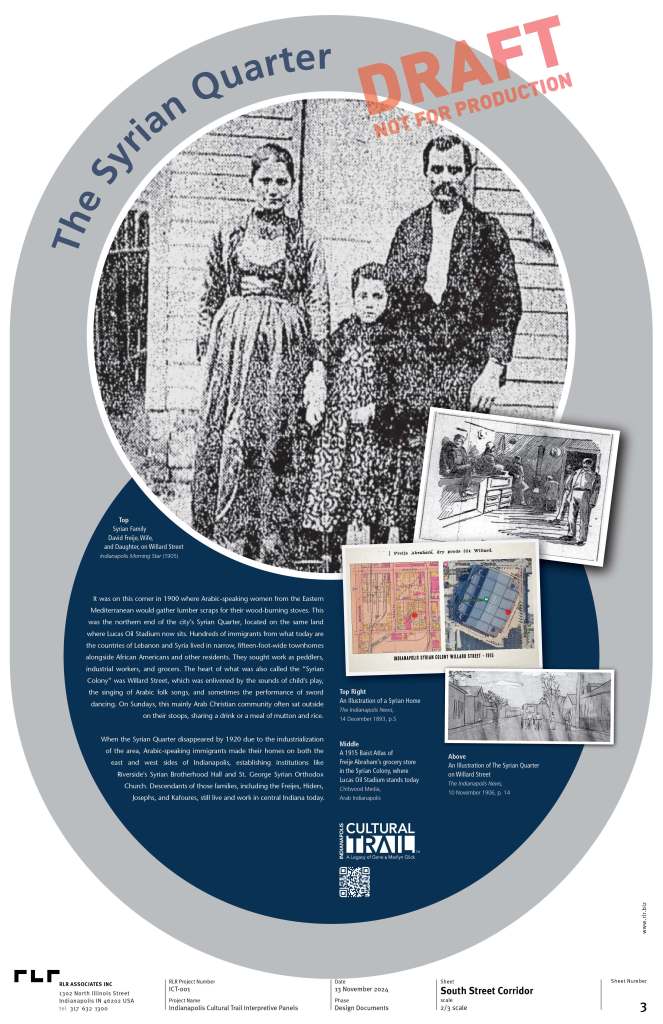
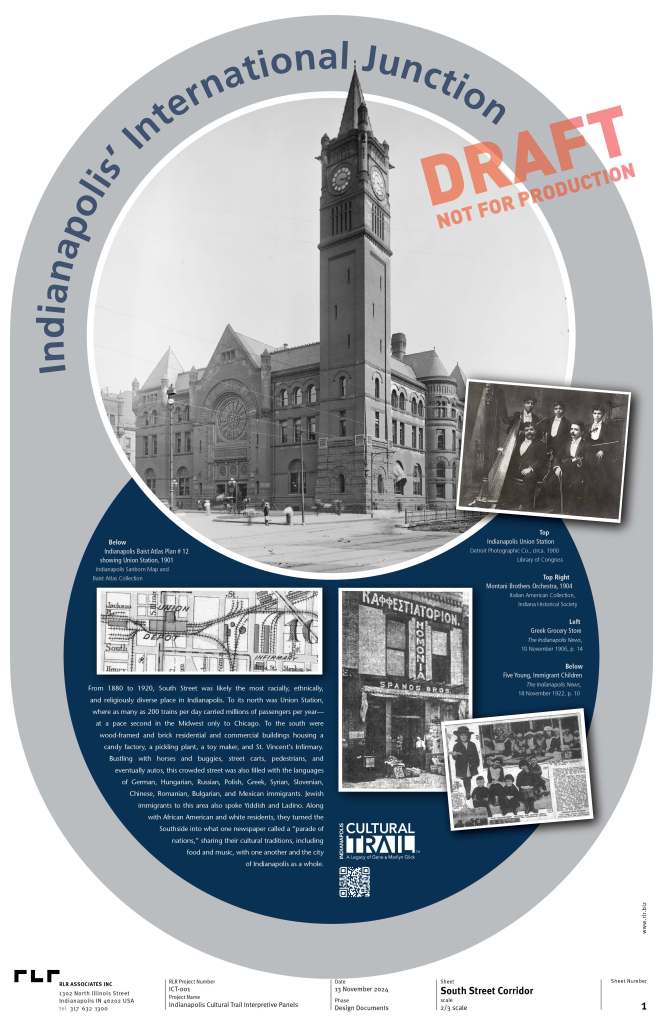
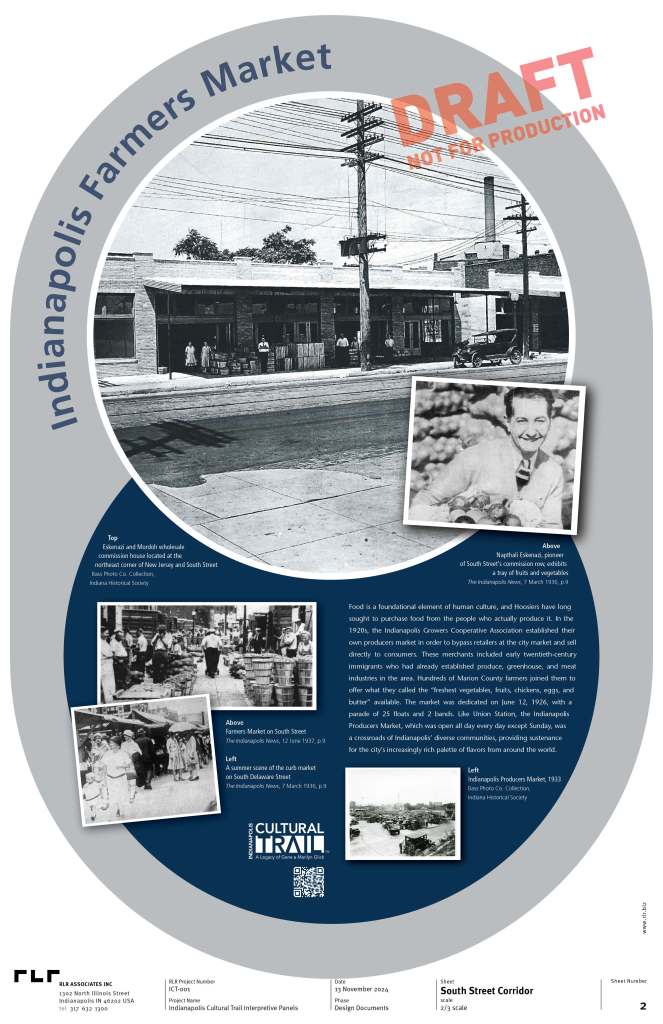
The selection of the sites for the panels was a team effort. City archivist Jordan Ryan, Prof. Sue Hyatt, and I worked together, each of us contributing what we knew about an area that has been home to the Syrian Quarter, Union Station, and the Farmers Market. The draft panels shared below, which are yet to be edited and installed, explore each of those places along the South Street extension of the trail.
I tried to evoke the cultural diversity of South Street at the dedication ceremony:
Just over there [pointing to South and Illinois], over 125 years ago, if you had gotten up early enough in the morning, you would discover Arabic-speaking women from what today are the countries of Syria and Lebanon. There was a lumber yard, and they came to gather scraps for their wood-burning stoves in their cramped town homes in the city’s Syrian Quarter, located somewhere near the 50-yard line inside Lucas Oil Stadium. Those women may have been humming, softly, and sometimes they were known to sing Arabic folk songs as they went about their work.
That’s just one example of the many cultural traditions part of South Street’s history.
The expansion of the Indianapolis Cultural Trail acknowledges the many immigrant cultures that made South Street the international hub of our city. In the early 1900s, millions of passenger per year would arrive and depart through Union Depot. In this place you would have heard every language spoken in Indianapolis—from Ladino and Yiddish to Chinese, Spanish, Greek, Slovenian, Polish, Romanian, Russian, Hungarian, and more. They brought their music and dancing to this place, too—when you entered Union Station you’d sometimes hear an Italian band of tuxedo-clad men striking up a tune. And if you continued along South Street both in distance and time you would have also discovered the city’s bustling Farmers Market, where residents purchased the ingredients they needed for their recipes from around the world.
The South Street expansion of the Cultural Trail helps us remember our true identity as a city. From the Miami, Potawatomi, and Shawnee to African Americans, European, Latin American, Middle Eastern, and Asian immigrants, and other groups, we have always been multi-religious, multi-lingual, multi-racial, and multi-ethnic. The South Street expansion reconnects us to this richly diverse past, making us a more welcoming city for all our people, today and in the future.
 Edward E. Curtis IV
You must be logged in to post a comment.